
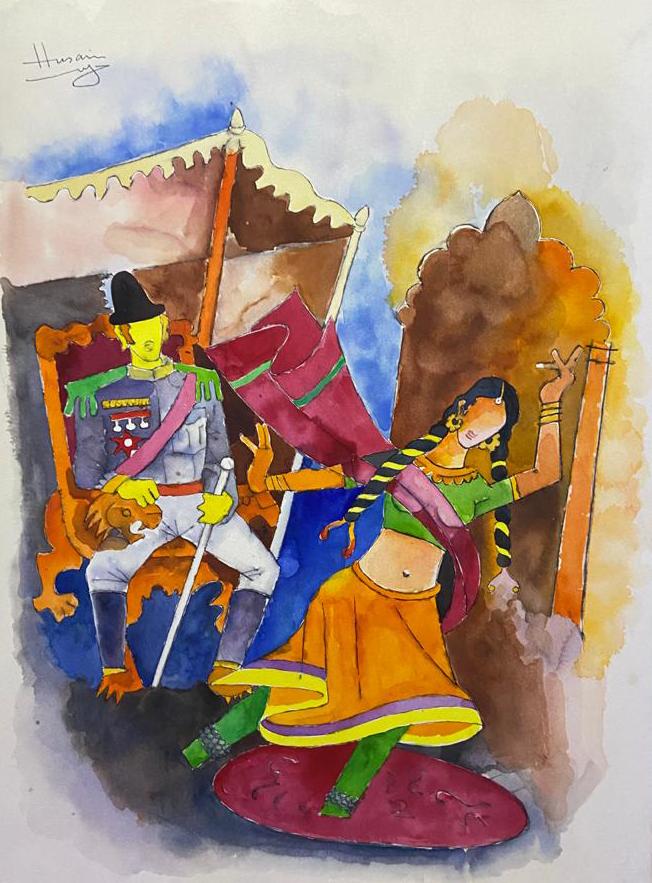
Description
M.F. HUSAIN
Maqbool Fida Husain, popularly known as M.F. Husain, was born on 17 September 1915 in Pandharpur and remains one of India’s most iconic modernist artists. Largely self-taught, he began his artistic journey painting cinema hoardings in Mumbai before emerging as a founding member of the Progressive Artists’ Group in 1947, which played a pivotal role in shaping post-Independence Indian modernism.
Often referred to as the “Picasso of India,” Husain developed a powerful visual language marked by bold colours, sweeping lines, and dynamic compositions. Drawing from Indian mythology, history, and everyday life, his narrative paintings—executed in a modified Cubist style—explored themes ranging from the Ramayana and Mahabharata to Gandhi, Mother Teresa, the British Raj, and urban–rural India. His works could be lyrical, caustic, humorous, or deeply sombre, reflecting the complexities of a rapidly transforming nation.
Beyond painting, Husain was a multifaceted creative force—filmmaker, writer, and designer. His experimental film Through the Eyes of a Painter won the Golden Bear at the Berlin International Film Festival in 1967, and he later directed Meenaxi: A Tale of Three Cities (2004), screened at the Cannes Film Festival. He received all three of India’s highest civilian honours—Padma Shri, Padma Bhushan, and Padma Vibhushan—and was a special invitee to major international platforms such as the São Paulo Biennial, exhibiting alongside global modernist masters.
In his later years, certain works sparked controversy and legal challenges, leading to a self-imposed exile from 2006. He lived and worked between the UK and Qatar, accepting Qatari citizenship in 2010. Despite these challenges, his artistic stature and influence remained undiminished. Husain passed away in London on 9 June 2011, leaving behind a legacy that continues to define and inspire modern Indian art.


Reviews
There are no reviews yet.